SolComms tested a month of fully location-flexible work in August 2026. Employees reported higher productivity and work-life balance, while revenue also increased. The experiment shows how companies can test remote flexibility without adopting a permanent remote policy, although small samples, self-reported results, security risks, and burnout concerns limit the evidence.
Lead & Significance
What Happened in August 2026
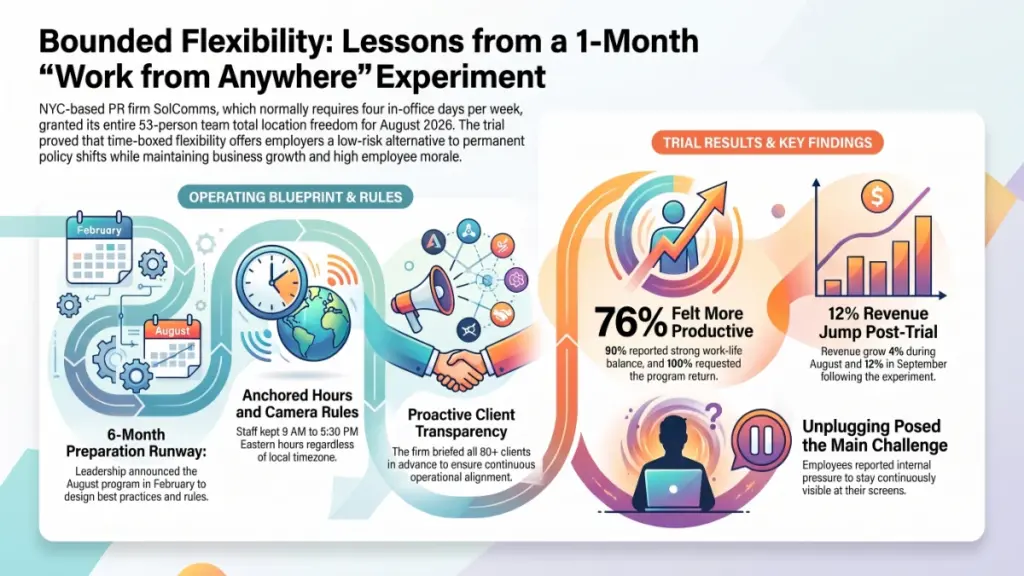
A New York City PR firm that requires four office days a week let its entire staff work from anywhere for a month. The firm is SolComms, and the experiment ran in August 2026. Founder and CEO Bruno Solari announced the plan to his 53 employees in February. Then the team spent six months preparing.
Staff logged on from Spain, Italy, Germany, Portugal, and several U.S. states. Solari himself traveled across Spain. By his own account, he would have felt like a hypocrite asking his team to sit in the office while he worked abroad.
The Headline Results
On paper, the results look strong. In a post-trial survey, 76% of respondents said they felt more productive. Meanwhile, 90% said they kept a high work-life balance. Every respondent wants the program back next year. Revenue also rose 4% from July to August, and 12% from August to September. As a result, Solari has already committed to a second round in August 2027.
Why the Story Matters
Three factors make this case worth attention. First, it comes from a founder who calls his own values traditional. Second, it arrives while large employers tighten office rules. Third, it shows a middle path between full-time office work and permanent remote work. Consequently, employers can grant intense, time-boxed flexibility without rewriting their whole policy.
This guide breaks down how SolComms ran the month. It also weighs the evidence and its limits. Finally, because I test remote work gear for a living, I look at what a month of “anywhere” work demands from your equipment.
Strategic Context & Why It Matters
A Tough Climate for Flexible Work
The experiment landed at an awkward moment. Employers hold the upper hand in today’s job market, and several large companies have pulled back on remote perks. In September, Uber announced plans to cut about 3,300 corporate jobs and to shrink its remote workforce. Disney, likewise, moved more employees to four office days a week and later announced about 300 layoffs.
Five-day mandates keep spreading as well. Flex Index research shows that the share of Fortune 500 companies requiring five office days nearly doubled in a year. It rose from 13% to 24% between mid-2024 and mid-2025. Consequently, workers have less bargaining power, and most leaders feel little pressure to expand flexibility.
The Bounded Alternative
SolComms went the other direction. The firm still requires four office days, with Fridays at home. Those Fridays end at 3 p.m. most weeks and at noon during the summer. Yet employees kept asking for more remote days in the company’s annual perks survey. Solari did not want to add a permanent remote day. Instead, he chose a bounded alternative: one month with total location freedom.
That choice reveals a useful management idea. Flexibility does not need to be permanent to carry value. A concentrated window lets employees do things a weekly schedule never allows. For example, they can visit family abroad, travel without burning vacation days, or skip the commute for four straight weeks. Meanwhile, the employer keeps its default policy and limits its risk.
Who Benefits From This Model
Several groups gain from a time-boxed approach:
- Employees gain a perk they value without a permanent policy change.
- Founders and managers get real data on remote performance before they commit to anything.
- Clients see continuity, because SolComms communicated the plan to its 80-plus clients in advance.
- Remote work vendors gain a use case: portable, reliable setups for people who change locations.
How Workflows Change
Workflows shift under this model. A team that sits together four days a week relies on hallway conversation and quick desk visits. A scattered team cannot do that. Therefore, SolComms replaced spontaneous contact with structure, setting core hours, camera rules, and Slack norms. In my view, that structure is the real product of the experiment. It shows that an in-office culture can translate to a remote month when leaders define expectations first.
Job seekers also benefit. Workers who feel locked out of flexibility can use this case to frame requests. A time-limited pilot asks for less than a permanent policy, so managers often say yes to small, measurable tests more readily than to sweeping changes.
Program Mechanics & Operating Rules
Timeline and Scope
I treat the SolComms program like a product spec. It had a clear scope, defined rules, and a long lead time. The leadership team conceived the idea in January and announced it to staff in February. After that, they spent six months designing best practices. That is a long runway for a four-week program, and the preparation likely explains much of the smooth execution.
Every employee could work from anywhere in the world for the entire month. Staff chose destinations across the U.S. and Europe. For instance, Natalie Valicenti, the associate vice president of operations, split her month between Rhode Island and Minnesota.
Working Hours and Meeting Norms
The company kept a single anchor schedule. Everyone worked 9 a.m. to 5:30 p.m. Eastern time. This rule protected collaboration, although it cost some personal convenience. A staffer in Lisbon or Berlin, for instance, would have started or finished at an unusual local hour.
Meeting rules were equally clear. Employees kept cameras on for all meetings and dressed as if they were heading into the office. Together, these policies preserved professionalism with clients and kept the team visible to each other.
Communication, Security, and Client Rules
Staff used Slack status updates liberally, so availability stayed clear without constant messaging. Management also stated outright that employees should take lunch and other breaks.
Security rules mattered too. The company banned sensitive calls and sensitive screens in public spaces. That rule carries weight for a PR agency serving clients across healthcare, tech and AI, and consumer brands. After all, a café table in Barcelona creates privacy risks that a desk in Manhattan does not.
Finally, SolComms told its 80-plus clients about the plan in advance. This step prevented surprise and let clients raise concerns before the month began.
What the Rules Demand From Your Gear
The program design shows several good practices. Leaders set a hard boundary on time and a soft freedom on place. They also wrote the rules down, which removed guesswork.
From a gear standpoint, however, those rules create real technical requirements. Camera-on meetings need a decent webcam and reliable lighting. Dress-code rules assume a clean, presentable background. Privacy rules push staff toward privacy screens and headphones. Likewise, fixed Eastern-time hours mean long evenings for anyone in Europe, so a comfortable chair and a proper laptop stand matter more in a rental apartment.
Performance, Benchmarks & Evidence
Survey Results
The company supplied survey data and revenue figures, and Make It reviewed the documents. I present the numbers as reported. I also note where they fall short of rigorous proof.
Twenty-one employees answered the post-trial survey. Of those, 76% said they felt more productive, 90% said they maintained high work-life balance, and 100% said they want Work from Anywhere August to return next year. In addition, several respondents said the month improved their communication and self-management skills. Many named the lack of a commute as the biggest draw.
Revenue Results
Revenue grew 4% from July to August. It then jumped 12% from August to September. Solari says finance was not the goal. Instead, he sees the figures as a pleasant side effect.
The Downsides
Some staff felt tied to their computers. Because no colleague prompts a lunch, coffee, or walk at home, they found it harder to step away than in the office. Solari calls this “internal pressure to be available” and says it is a common remote work problem.
That finding deserves attention. Remote workers often report higher productivity, but part of that gain may come from longer hours rather than better output. The SolComms staff described exactly this risk. Indeed, a worker who never leaves the laptop can burn out even while the survey says “productive.”
How to Read the Numbers
The headline figures look impressive, but the sample is small. Twenty-one respondents answered at a company with 53 employees, which is roughly 40% of staff. Moreover, the company did not say how it chose respondents or whether the survey was anonymous. Employees who enjoyed the month may also have answered at higher rates.
The revenue data has its own problems. A 4% rise over one month does not prove cause, since August and September often bring seasonal swings in client budgets. In addition, a three-year-old startup grows quickly by default. Without a control group or a prior-year baseline, the revenue figures offer context rather than proof.
Still, the data points in a consistent direction. Productivity self-reports, work-life balance, and revenue all moved positively, and no metric moved the wrong way. For a first trial, that is a reasonable outcome.
Comparison to the Broader Market
An Owl Labs survey of 2,000 people in July offers useful context. It found that 25% of full-time U.S. workers have hybrid arrangements, with three office days the most common requirement and four next. Meanwhile, 65% work onsite full time and 10% work remotely full time. Therefore, SolComms sits inside the common hybrid range, which makes its experiment relevant to many employers.
Pricing, Licensing & Availability
Work from Anywhere August is not a product. SolComms did not sell it or license it, so no fee applies. Even so, the program has costs and an availability profile that other employers should understand.
Direct Costs
The article reports no budget figure. The visible costs were planning time and leadership attention. The company spent six months on best practices, and it also spent time communicating with clients. The article does not say whether SolComms offered travel stipends, so employers should settle that question in their own programs.
Indirect Costs
Time-zone gaps can slow collaboration, and security risks rise when people work from public spaces. SolComms managed both through rules rather than spending. However, a firm with stricter compliance needs might require extra tools, such as company-managed VPNs or encrypted devices.
Availability and Licensing
The program ran once, in August 2026, and Solari plans to run it again in August 2027. The company has not described a permanent policy beyond that. Because the model is an HR practice rather than intellectual property, other employers can copy it freely.
What It Costs to Replicate
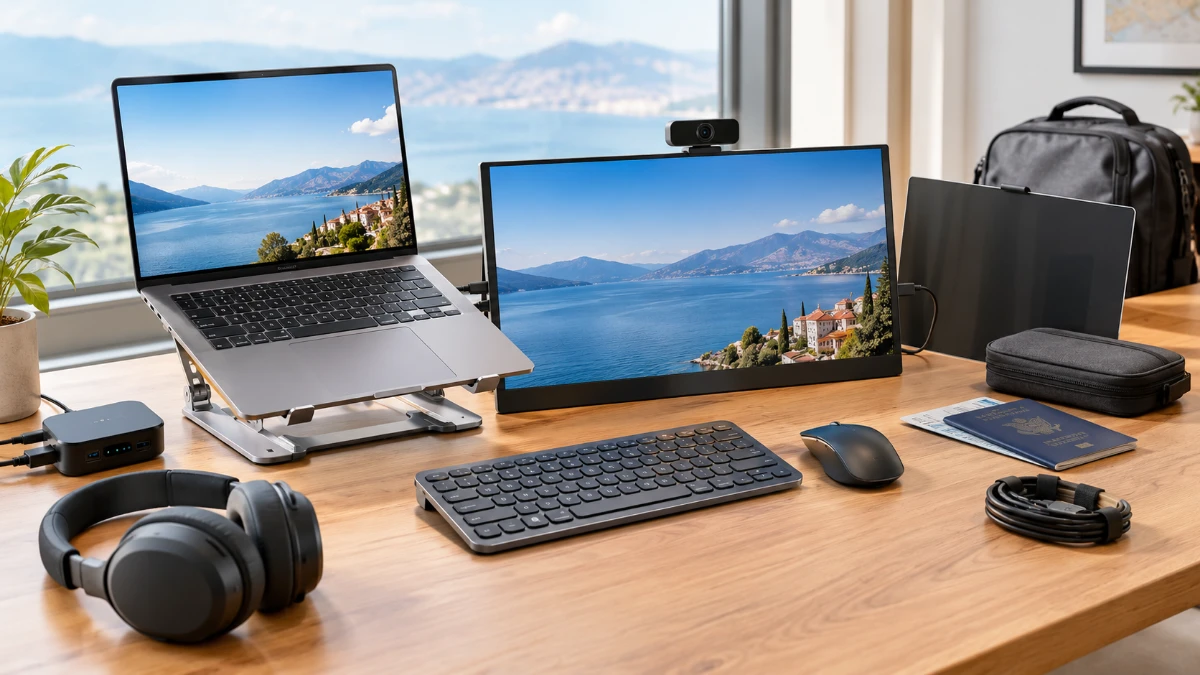
Managers who want to try this should budget mostly for preparation: policy writing, manager training, and client communication. Employees, in contrast, carry the cost of their own setup. For a month of work from anywhere, I recommend the following:
- A compact laptop stand and a portable keyboard. They protect your posture in rentals with bad tables.
- A good webcam or a laptop with a strong built-in camera. Camera-on rules punish blurry video.
- Noise-cancelling headphones. They help in shared spaces and keep client calls private.
- A privacy screen filter. It supports the no-sensitive-screens rule.
- A travel router or a mobile hotspot backup. One failed Wi-Fi connection during a client call hurts credibility.
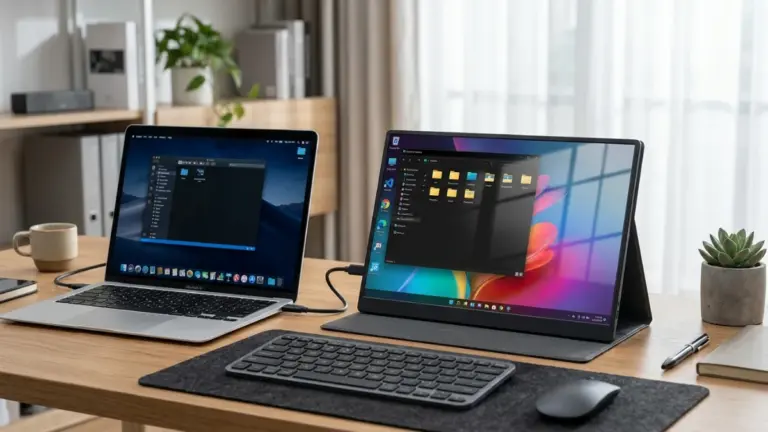
- A portable monitor. It cuts the productivity penalty of working from a single small screen.
Those items cost real money, so compare models before you buy. My buying guides at DeskCreator.com test each category for build quality, portability, and value.
Next, a resource for readers who want to turn flexible work into income.
Industry Implications & Competitive Analysis
SolComms competes with several other approaches to flexibility. Each has strengths and weaknesses, and the comparison clarifies where this model fits.
Versus Full-Time Office Mandates
Companies like Disney now ask for four days, and a growing share of Fortune 500 firms ask for five. Their argument rests on culture, mentorship, and collaboration. SolComms shares that argument, since Solari values in-person interaction over screen-based culture. Yet his experiment shows that a company can keep this belief and still test flexibility. The two ideas conflict less than many leaders assume.
Versus Permanent Remote Policies
Fully remote companies offer location freedom all year. That model attracts talent, but it demands strong documentation habits and deliberate culture building. SolComms offers location freedom for one month. Thus, it captures part of the benefit without the structural change. The tradeoff is clear: employees get less, and the employer takes less risk.
Versus an Extra Weekly Remote Day
Solari said he felt wary of adding a permanent remote day. A fifth remote day would shift the firm toward a different identity. A monthly window avoids that shift. Furthermore, it creates a memorable event, which may build more goodwill than a quiet policy tweak.
Versus Workation and Sabbatical Programs
Some employers offer extended unpaid leave or “workation” weeks. Those programs usually require approval for each employee. SolComms applied the perk to everyone at once. As a result, the design avoids resentment and approval bottlenecks, and it gives the company a clean dataset for comparison.
Market Signals to Watch
Three trends stand out.
- Large employers are tightening rules, which leaves a gap for smaller firms that use flexibility as a recruiting tool.
- Workers still request more remote days every year, even in a tough job market. The demand has not faded.
- Time-boxed experiments offer a low-risk way to gather evidence. Managers who lack data tend to default to the strictest policy.
Implications for the Workspace Industry
A work-from-anywhere month raises demand for portable, durable gear. Travel-friendly monitors, compact docks, and foldable stands fit that need. It also boosts demand for software that supports asynchronous work, such as chat platforms and video tools. Home office furniture may matter less during such a month. Nevertheless, a well-built home setup still anchors the other eleven.
For employers, the lesson is practical. Write rules before you grant freedom. Communicate with clients early. Survey staff afterward, and then compare results to your baseline.
Limitations, Caveats & Skepticism
I find the SolComms story encouraging, but I would not treat it as proof that every company should copy it. Several limits apply.
Gaps in the Evidence
Small sample. Twenty-one responses cannot represent a whole workforce, let alone an industry. Self-selection could also inflate the positive results.
Self-reported productivity. Surveys measure how people feel, not how much they produce. People tend to say they worked better in settings they enjoy. Objective measures, such as billable hours, client satisfaction scores, or deliverable turnaround times, would give a stronger picture. The article cites none.
Revenue is not causal evidence. The 4% and 12% increases look good. However, seasonal patterns, new client wins, and normal startup growth could explain them. Solari himself says finance was not the goal, so readers should avoid concluding that remote months raise revenue.
Industry Fit and Security Exposure
Industry fit. A PR agency relies on phones, email, and video calls, so its work moves easily across locations. A manufacturer, a hospital, or a retail operation cannot offer location freedom in the same way. Even within office-based industries, roles that need secure facilities or specialized hardware face limits.
Security exposure. Working from rentals, cafés, and airports increases risk. SolComms banned sensitive calls and screens in public spaces. Still, enforcement depends on employee judgment, and the article describes no audit or monitoring.
Equity, Burnout, and the One-Trial Problem
Equity concerns. Not every employee can travel. Some have caregiving duties, visa limits, or tight budgets. Consequently, a work-from-anywhere month can feel like a perk for people with money and flexibility. The article does not say whether SolComms addressed this issue.
Burnout risk. Staff reported feeling tied to their computers, and a month of that pattern can hurt wellbeing. Leaders need to push breaks and boundaries, not just permit them. Solari’s comment about being “chained to a desk” suggests he understands the risk. Understanding it and fixing it, however, are different tasks.
One trial only. The company ran this experiment once, so novelty may have boosted morale. A second or third run could show weaker effects. The 2027 repeat will provide a more useful test.
None of these caveats cancel the findings. Rather, they define how much weight to give them. The experiment offers a promising signal and a practical template, but it does not settle the remote work debate.
Future Outlook & Conclusion
What to Watch Next
SolComms plans to run Work from Anywhere August again in 2027. Solari says he is “1,000% doing it again.” That commitment gives the company a second data point and lets it refine its rules. Several developments deserve attention over the next year:
- Better metrics. If SolComms tracks output data in 2027, the evidence will improve. Watch for objective measures beyond surveys.
- Policy creep. A successful month may tempt the company to extend the program. Because Solari wants to preserve in-person culture, any expansion will test that belief.
- Copycats. Other small and midsize firms may adopt similar pilots, especially in client-service industries.
- Return-to-office trends. If large employers keep tightening rules, flexible small companies may gain a recruiting edge. Should the labor market loosen, employee leverage could return.
- Tooling. Vendors will likely market more products to the work-from-anywhere crowd. Judge each product on tested performance, not on branding.
Takeaways for Workers, Managers, and Workspace Builders
For workers, the takeaway is practical: pitch a pilot instead of a permanent change. Offer clear rules, a defined time frame, and a way to measure results. Managers, in turn, should prepare early, write the rules down, and ask their teams for honest feedback afterward.
For anyone who builds a workspace, the lesson is that a good setup travels. Invest in gear that supports a quality camera, clear audio, good posture, and reliable internet wherever you work. A month in Lisbon and a month in your spare bedroom should feel equally productive.
Final Verdict
SolComms did not prove that remote work always wins. Instead, it showed that a company with traditional values can test flexibility, collect data, and keep its culture. That claim is smaller than the hype around remote work often suggests, but it is more useful. I will track the 2027 results and update this guide when new numbers appear.